10 Tax Questions Every Newsletter Writer Should Ask Before Going Paid
You turned on paid subscriptions and money started landing in Stripe. But who files the VAT — you or the platform? Ten plain answers on newsletter taxes, from Merchant of Record to reverse charge, with the EU as a worked example.

You turned on paid subscriptions. Money started landing in your Stripe account. And somewhere between "I have my first paying subscriber" and "wait, do I owe tax on this?", most newsletter writers just... stop asking questions and hope for the best.
That's a risky bet. Your newsletter platform — Substack, beehiiv, whatever you picked — almost certainly isn't handling your VAT or sales tax for you, even though it feels like it should.
Below are the ten questions worth asking before (or right after) you flip the paid switch, answered plainly. The Netherlands and the wider EU serve as the detailed worked example, because those rules are unusually well documented — but most of the logic applies everywhere.
Quick disclaimer: this is general information to help you ask your accountant the right questions, not tax or legal advice. Rules vary by country and change often — verify specifics with a professional before filing anything.
1. Do I actually owe tax on my newsletter income?
If you're taking money for a paid subscription, almost every tax authority in the world considers you to be running a business — even if you think of yourself as a hobbyist with a day job.
In the Netherlands, for example, the moment you charge for access to your writing, the Belastingdienst treats you as an ondernemer voor de btw (an entrepreneur for VAT purposes), whether or not you ever registered a company.
The label you use for yourself ("hobby," "side project," "creator") doesn't change how tax authorities see the transaction.
2. Does my platform (Substack, beehiiv, etc.) collect and file this for me?
Almost certainly not — and this is the single biggest misconception among newsletter writers. Substack and beehiiv both connect to your own Stripe account. The money flows from your reader straight to you; the platform only pulls its cut afterward.
Legally, that makes you the seller, not the platform.
Neither Substack nor beehiiv registers with tax authorities, collects VAT on your behalf, or files anything for you. If you want a platform that does that job for you, you need a Merchant of Record (more on that below).
3. What's the actual difference between a "payment processor" and a "Merchant of Record"?
This is the distinction that decides how much tax admin lands on your desk:
- Payment processor / software platform (Substack, beehiiv, a self-hosted Ghost + Stripe setup): you are the legal seller of the subscription. You calculate, collect, and file all applicable VAT/sales tax yourself.
- Merchant of Record (MoR) (Patreon, Lemon Squeezy, Paddle, and nowadays Stripe's Managed Payments): the platform legally buys your content from you and resells it to your reader. They register as the seller, collect the right local tax, and file it. You just get paid.
Neither approach is "better" outright — it's a trade-off between a lower fee and doing the paperwork yourself (payment processor) versus a slightly higher fee and near-zero tax admin (MoR).
4. I have readers all over the world — do I charge everyone the same VAT?
No, and this is where most writers get it wrong.
Using an EU-based writer as the example, your readers fall into distinct tax buckets:
- Readers outside the EU (US, UK, most of the rest of the world): this is a genuine export of services. You charge 0% VAT, but you still have to prove — usually via at least two matching pieces of evidence from your payment processor (billing address, IP location, card country) — that the customer really is outside the EU.
- Readers inside the EU, outside your home country: not automatically zero-rated. See question 5.
- Readers in your home country: standard domestic VAT rules apply (see question 6 for the newsletter-specific twist).
Private individual or registered business?
One distinction cuts across every bucket above: is the subscriber a private individual or a registered business?
Everything so far assumes a private reader (B2C). If a subscription is paid for by an EU company — someone expensing it, or a team plan billed to a business — and that business provides a valid EU VAT number, the transaction is B2B instead. In that case the rule flips entirely: you charge no VAT at all, and the business customer self-assesses it in their own country under the reverse charge mechanism.
This applies the same way regardless of where you're established — an EU writer selling to a German company's team subscription and a US writer selling to that same company work identically. The catch is evidence: you need the customer's valid VAT number (checkable via the EU's VIES tool) on file to justify not charging VAT. Without it, you have to assume they're a consumer and charge accordingly.
If you're a US-based writer, don't assume VAT is someone else's problem — it applies to you too, just on a different trigger than at home:
- Domestically, the question is whether you've crossed economic nexus thresholds in individual states (commonly $100,000 in annual sales to that state, though rules vary) and whether that state taxes digital subscriptions at all — genuinely state-by-state; some tax digital newsletters, some don't.
- For your EU private readers, there's no threshold to wait for: non-EU businesses owe EU VAT from their very first euro of B2C sales, via the non-Union OSS scheme (see question 5). For EU business subscribers, you're in the easier position described above — no VAT to charge, no OSS registration needed for those sales, just a VAT number to keep on file.
5. What happens once my EU cross-border sales get bigger?
For an EU-based writer selling to consumers in other EU countries: below €10,000 per year in total cross-border EU sales, you can simply charge your home country's VAT rate on all of them. Cross that threshold, and you're technically required to charge the local VAT rate of each customer's country — 9% in one country, 22% in another, and so on.
Nobody wants to register for VAT in 27 countries individually, which is exactly why the EU built the One-Stop Shop (OSS): one quarterly filing, submitted through your home tax authority, that covers every EU country you sold into. If you're an EU-based writer with any meaningful international subscriber base, registering for OSS early is worth doing before you're forced to.
Two things worth knowing:
- The €10,000 is cumulative across all other EU countries combined, not a per-country allowance — €4k to France + €4k to Spain + €3k to Germany = over the threshold even though no single country hit €10k.
- It's checked against both the current and the previous calendar year — so a writer who crossed it last year doesn't reset to zero on January 1.
6. Do digital newsletters get taxed at a lower rate than "normal" digital services?
Often, yes — and most writers have no idea this exists. Under Council Directive (EU) 2018/1713, EU member states are allowed to apply the same reduced VAT rate to electronic publications that they already apply to print. Following that directive, most EU countries (plus the UK, which kept the rule after Brexit) now apply their reduced or even zero rate to e-publications rather than the standard digital-services rate.
For a newsletter specifically, tax authorities generally look for:
- Publication at least a few times a year at regular intervals
- The same content going to every subscriber (not 1-on-1 personalized consulting dressed up as a newsletter)
- Content that isn't predominantly advertising or video/music streaming
In the Netherlands, that means a qualifying newsletter can be taxed at 9% instead of 21% for domestic subscribers — and the reduced rate carries through to your OSS filings for other EU countries too, where those countries have adopted their own reduced e-publication rate. Whether your newsletter qualifies, and what the reduced rate is in a given country, is worth confirming with an accountant rather than assuming.
7. What about free welcome gifts for new subscribers — are those taxed separately?
This used to be a genuine headache, and a 2023 European Court of Justice ruling cleared it up. In Deco Proteste – Editores (Case C-505/22), the Court ruled that a welcome gift offered specifically to attract a new subscription — the case involved tablets and smartphones — is an ancillary part of the subscription, not a separate taxable supply.
In plain terms: if you give new subscribers a free ebook, template, or small physical gift tied to signing up, you generally only account for VAT on the subscription itself, not the gift on top. This is an EU-wide ruling, so it applies regardless of which member state you're in.
8. Do I owe tax on the cut my platform takes — like Substack's 10%?
Yes, and this one surprises almost everyone. When Substack (a US company) takes its 10% fee, it's providing you — an EU business — with a cross-border B2B service. For an EU-based writer, that means applying the reverse charge mechanism: you self-assess the VAT you would have been charged, report it as tax owed in one section of your return, and immediately reclaim the identical amount as input tax in another.
The net cash effect is zero, but the reporting obligation is real, and skipping it is a compliance gap that shows up in an audit.
A related point when it's time to file your annual income or corporate tax: report the full gross revenue your readers paid, not just what landed in your bank account after fees. The platform's cut and your payment processor's fees are then claimed separately as deductible business expenses.
9. I'm not a "real business" — I just turned on paid subscriptions as a side thing. Does any of this apply to me?
Yes. Most platforms, including Substack, don't let a private individual (a "consumer") sell paid subscriptions at all — their terms of service classify anyone charging for content as a commercial entity the moment they flip that switch. So the "accidental business" is very real: you may not have registered anything, but tax authorities will typically treat you as one anyway.
The audit risk here is concrete, not theoretical. Under EU rules known as CESOP, payment processors are required to report cross-border payment volumes to tax authorities. If money is visibly flowing into your account from readers across multiple countries and you haven't filed anything, that's exactly the kind of pattern that gets flagged.
10. Which platform makes this easiest — and is self-hosting actually worth it?
Worth being precise about the categories here, since they get conflated a lot: Substack, beehiiv, and Patreon are full newsletter platforms — they host your content and send your emails. Lemon Squeezy, Paddle and Stripe are checkout tools that act (or can act) as a Merchant of Record. You can't "switch to" Lemon Squeezy the way you'd switch to beehiiv; you bolt it onto a platform that lets you plug in an external checkout, like a self-hosted Ghost site. Substack and beehiiv don't allow that at all — not even through Stripe Managed Payments, although Stripe is their payment platform.
The real options
So the real options are four full setups, not a grab-bag of platforms. On a single €10.00/month subscription, the fee structures compare roughly like this: on Substack, after the 10% cut, ~2.9% + €0.30 processing, and a 0.7% billing fee, you're left with roughly €8.34 — and you still owe the full VAT filing job on that money. Route the same €10.00 through Lemon Squeezy, and you keep closer to €9.00, with VAT collection and filing already done.
Scaled up to a newsletter earning €2,500 per month in subscriptions, the four main setups compare like this:
| Substack | beehiiv (Scale plan) | Patreon | Self-hosted Ghost + Lemon Squeezy | |
|---|---|---|---|---|
| Platform revenue cut | 10% (€250) | 0% | 8–12% (~€200–€300) | 0% |
| Fixed monthly fee | €0 | ~€45 | €0 | ~€15 (server + email tool) |
| Card processing | ~€100 | ~€100 | included in plan rate | included in MoR fee |
| MoR fee | — | — | included in plan rate | ~€160 (5% + €0.50) |
| Total monthly cost | ~€350 | ~€145 | ~€300–€375 | ~€175 |
| Who files your EU VAT? | You do (OSS) | You do (OSS) | The MoR does — fully hands-off | The MoR does — fully hands-off |
A cost none of these headline numbers include: currency conversion. Every platform quotes its domestic rate — the moment a subscriber pays with a non-domestic card, or your payout currency differs from theirs, an extra charge gets layered on top, and it's easy to miss because it's baked into the processing line rather than broken out:
- Lemon Squeezy adds a flat +1.5% on top of its base fee for any non-US transaction.
- Patreon's advertised 8–12% plan rate commonly works out closer to 12–15% in practice once currency conversion is included.
- Substack and beehiiv both run on Stripe, whose standard pricing adds +1.5% for an international card, and another +1% if it also has to convert currencies — so a US-based writer with EU readers, or vice versa, can lose an extra 1.5–2.5% that doesn't show up anywhere in the headline "10%" or "5%" figure.
If a meaningful share of your subscribers pay in a currency other than the one you get paid out in, add a percentage point or two to every headline number before comparing platforms.
What this actually tells you:
- Substack loses on both counts at any meaningful revenue — it's the most expensive setup and you still own 100% of the VAT filing. There's no revenue level where it comes out ahead of the alternatives.
- beehiiv vs. self-hosted + Lemon Squeezy is the real trade-off. beehiiv can be cheaper in raw monthly cost because its fee is flat rather than percentage-based — but you still file every VAT return yourself, at any revenue. Self-hosting costs a bit more but hands VAT off entirely.
- Patreon sits close to Substack on fees but is a genuine Merchant of Record, so it's the one case where "pay roughly what Substack costs, but never touch VAT" is a real option without migrating platforms.
There's no universally "right" answer — it depends on how much revenue is at stake, how many countries your subscribers are in, and how much of the compliance work you actually want to own.
Knowing your real numbers matters more than which platform you pick
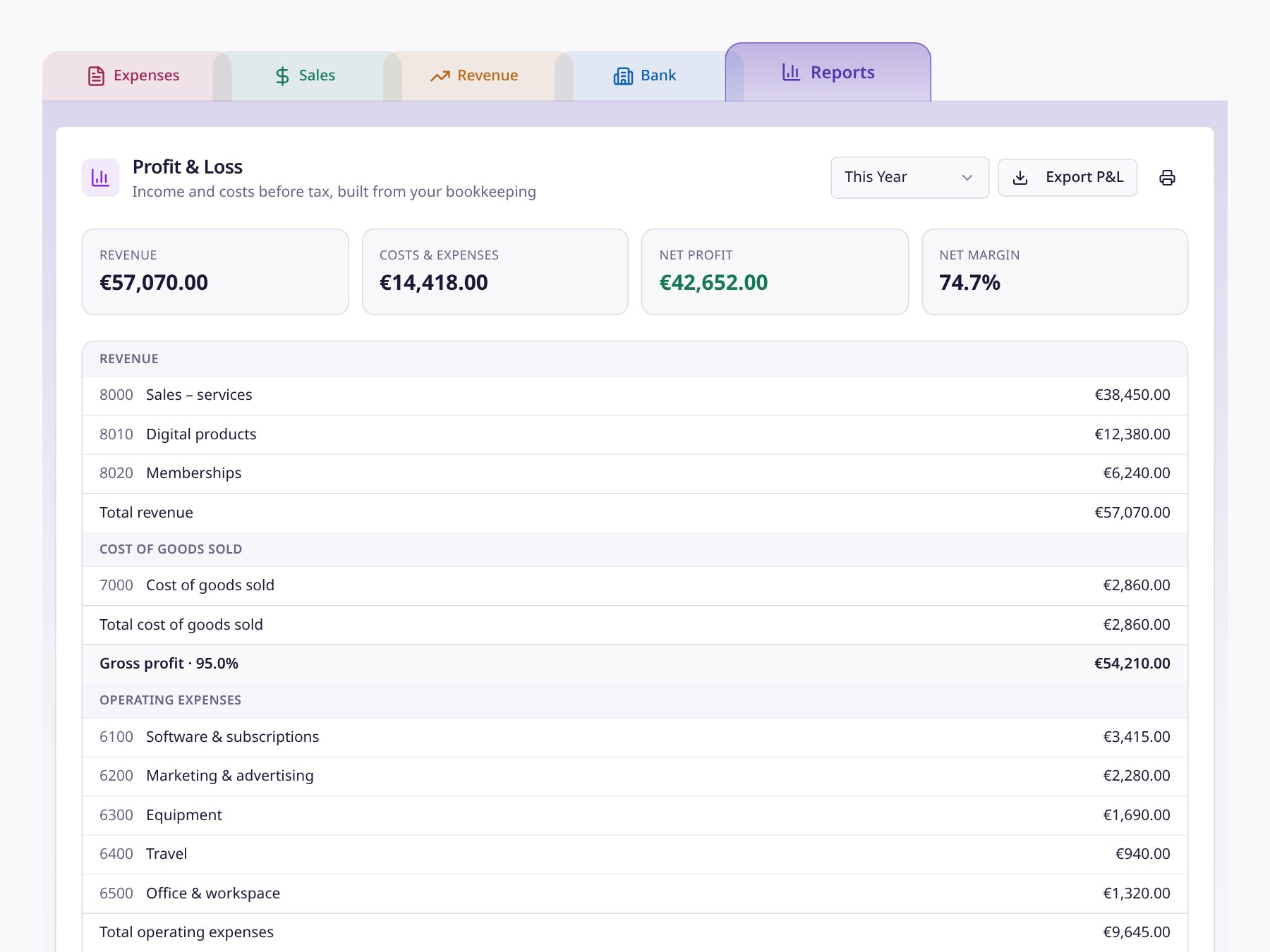
Whichever route you choose, the trap is the same: the number your platform shows you is never the number that's actually yours. Gross subscriber revenue minus platform fees minus processing fees minus VAT minus quarterly tax minus reverse-charge obligations is a lot of subtraction to do in your head every month.
That's the specific gap Money Magician was built for — connecting your Stripe account, automatically separating platform fees, VAT, and tax set-asides from your real take-home, and flagging what you actually owe before it becomes a surprise at filing time.
This article covers general principles current as of 2026 and uses the Netherlands/EU as a detailed example. Tax rules vary by country and change frequently — always confirm your specific situation with a qualified accountant before filing.
Frequently Asked Questions
Do I owe tax on my newsletter income?
Almost certainly yes. The moment you charge for access to your writing, most tax authorities treat you as running a business — even if you think of it as a hobby or side project. In the Netherlands, for example, you are an entrepreneur for VAT purposes from your first paid subscriber, whether or not you ever registered a company.
Does Substack or beehiiv collect and file VAT for me?
No. Both platforms connect to your own Stripe account, so the money flows from your reader straight to you and the platform takes its cut afterward. Legally you are the seller, which means you calculate, collect, and file all applicable VAT or sales tax yourself. Only a Merchant of Record platform (Patreon, Lemon Squeezy, Paddle, Stripe Managed Payments) takes that job off your desk.
What is a Merchant of Record?
A Merchant of Record (MoR) legally buys your content from you and resells it to your reader. The MoR registers as the seller, collects the right local tax, and files it — you just get paid. The trade-off is a slightly higher fee in exchange for near-zero tax admin, versus a lower fee and doing all the paperwork yourself with a plain payment processor.
Do I charge the same VAT to readers in different countries?
No. For an EU-based writer: readers outside the EU are generally 0% VAT (an export of services, with evidence required), readers in other EU countries follow the €10,000 cross-border threshold and the One-Stop Shop scheme, and readers in your home country follow domestic rules. Business subscribers with a valid VAT number flip to the reverse charge mechanism, where you charge no VAT at all.
Do digital newsletters get a reduced VAT rate?
Often, yes. Under Council Directive (EU) 2018/1713, EU member states may apply the same reduced rate to electronic publications as to print. In the Netherlands a qualifying newsletter can be taxed at 9% instead of 21%. Qualification generally requires regular publication, the same content for every subscriber, and content that is not predominantly advertising or streaming.
Do I owe tax on the fee my platform takes?
Yes, in a reporting sense. When a US platform like Substack takes its fee from an EU-based writer, that is a cross-border B2B service subject to the reverse charge mechanism: you self-assess the VAT and reclaim the identical amount as input tax. The net cash effect is zero, but skipping the reporting is a compliance gap. You should also report your full gross revenue at year-end, not just the net payout.